I am trying to write three books and am constantly complaining about how little time I have to accomplish anything due to my 50-60 hour a week day job, so a lot of blogging about comics has fallen to the wayside. However, since I read the first three issues of Fear Itself this weekend despite rarely reading any of the big crossover events, I thought I would weigh in, albeit briefly.
I don't get it.
Less briefly, I don't know why I'm supposed to care about this story. Granted, I've been out of the mainstream of Marvel for years, only checking in briefly when X-Factor has an obligatory tie-in to the major event or getting summaries from Twitter that lead me to Wikipedia to learn why and how Norman Osborne is in charge of the world or whatever the hell that was about. Still, I don't think my ignorance of current storylines is what's holding me back.
It just seems like a by-the-numbers "major threat is posed to the world and the superheroes band together to fight it off" story, but without anything to get me actually interested. It feels like it's been put together by a committee that drew up specific guidelines based on past event comics. Destroy major cities, turn heroes against one another, kill off a notable character who also happens to be totally expendable,, etc. In this case, the committee also realized the series would kick off during the hype of the Thor movie, and that the general public would expect Steve Rogers to be back as Captain America in time for that movie, so in addition to the other points, the threat should be Norse-related and Bucky would have to die or otherwise be removed from his role as Captain America.
In reading the third issue, one moment really stood out for me as even more out of place and awkward than everything else. I assumed this was Matt Fraction's nod to the old tradition of the Yancey Street Gang razzing the Thing whenever he came back to the old neighborhood, but this seemed a little extreme. Why would you heckle the superheroes who have saved the world multiple times when another threat is being posed to the planet as we know it? This feels like a Jew during the liberation of Auschwitz yelling, "Hey, Americans, I sure hope you unlock those gates faster than you fought the Battle of the Bulge, ya jerks!"
Then I realized if I lived in the Marvel Universe, I might feel this way, too.
For nearly a decade, Marvel citizens have lived under an almost-constant threat of annihilation. The disassembling of the Avengers and subsequent demutanting of the populace were minor blips compared to the Civil War that saw a nuclear explosion wipe out Stamford, Connecticut and a battle between superheroes that destroyed several blocks of Manhattan.
Significant chunks of New York City have also been destroyed in the Skrulls' Secret Invasion and World War Hulk, as well as Hell's Kitchen being transformed into a demonic feudal kingdom under the leadership of Daredevil. At this point, if Galactus comes down and says, "I'm going to eat your planet," the average guy must think, "Ho-hum, speaking of eating, what should I make for dinner?" For shocking twists to be shocking, for tense moments to be tense, for dire consequences to be dire, there needs to be some downtime. Otherwise, the rebirth of an ancient Norse god of fear taking control of the most powerful heroes and villains and bending them to his will with the intent of razing the planet is just another day in the Marvel Universe.
I just don't have it in me to criticize the first issue of Onslaught Reborn, largely because there isn't much story to criticize. The book is nothing but an attack by Onslaught on the Baxter Building, meaning Loeb is relying on Rob Liefeld's art to carry the day.
I wanted to do a big panel by panel examination of Liefeld's art, but after five pages I was wiped and in need of a Jimmy Olsen comic to cleanse my palate, so all I give you is:
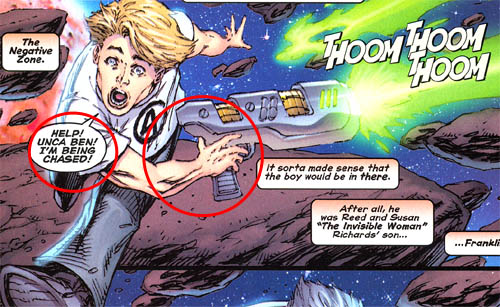
2. That gun is floating. Franklin Richards isn't gripping it.
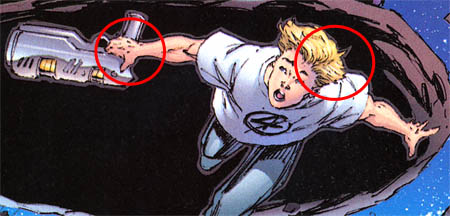
4. Franklin's part just switched sides. This is one frame later and on the same page as the previous panel.
I guess it should be noted though that there are four wrists in those two panels, which is four more than more Liefeld comics.
And finally, it's Thing and Torch's gay porn video!

First off, let me clarify I've only read the first volume of Essential Fantastic Four so it's entirely possible Reed Richards has said stupider things than this, but from where I stand, for the following words to pour out of the mouth of "the greatest scientific mind on the planet" in Fantastic Four #20 is bewildering: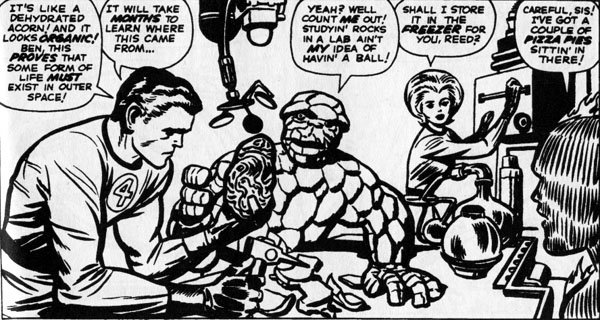 Wow, what a discovery! Evidence of life from outer space! It's like a big acorn in need of thorough analysis. Just think of what this will teach us about the possibilities of alien life. It's almost as big a deal as what happened two months ago. Remember that Reed?
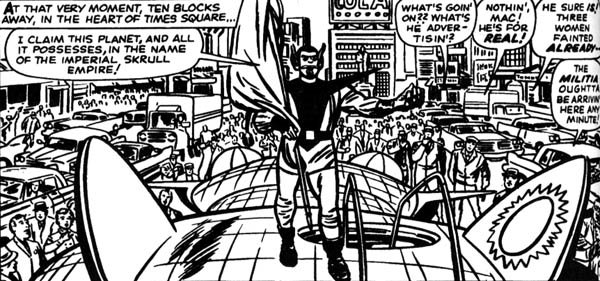 Oh, yeah! The Super Skrull landing in Times Square and claiming the planet Earth in the name of the Skrull Empire. As I recall, he was sent here to prepare us for the invasion the Skrulls had planned about two years ago.
Your remember the Skrulls, right, Reed?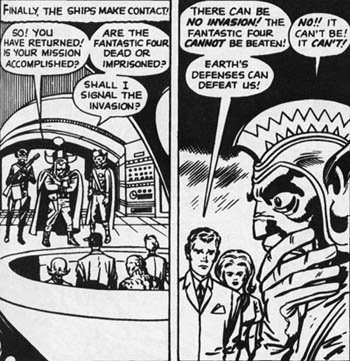 Right, right, now it's coming back. You and the rest of the team had to fly up to their mothership, posing as the Skrull undercover unit sent to Earth to mimick you and discredit the FF. You convinced them to call off the invasion by showing them pictures from comics books.
Don't remember? I suppose you have a lot on your mind and shapeshifting aliens coming to Earth is just two days out of your entire life.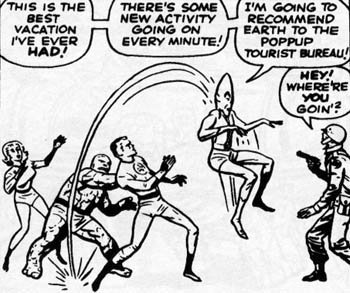 No, wait, three days. Almost forgot about Impossible Man. What a pest he was, huh? I mean, he's no Doctor Doom, but he still made life tough for a while.
Speaking of Doom, remember he told you that story about those aliens he met after you guys and Namor turned his plan to hurl you all helplessly into space around on him and left him drifting into the void?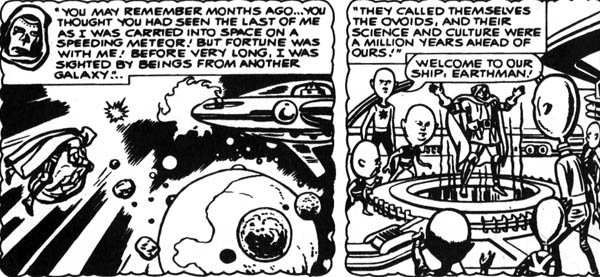 Man, was he mad when he returned. He almost killed you and everyone else on the team. Good thing you learned your lesson and recognize you can't just go shooting people who pose a threat off into space without there being some dangerous consequences. If you ever tried something like that again, I bet Namor would totally oppose it.
Of course, this isn't really evidence of alien life since it's just a story from Doom. Kind of like how the Watcher told you the story about his home planet when you ran into him on the moon.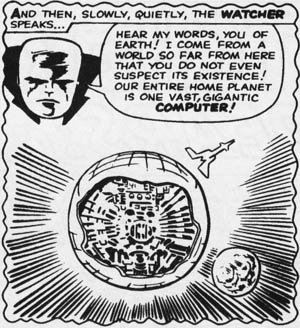 Anecdotal evidence isn't enough for a scientist of your caliber, so I can understand dismissing those tales. It's not like the aliens came to you, took you up in their ship, flew you to their homeworld where you saw millions more of them, and made you save their race from an asteroid that was on course to destroy their planet.
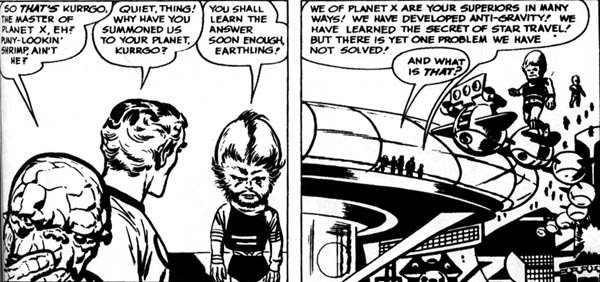 At least not in the last year or so.
Anyway, Reed, I guess what I'm saying is "Best of luck on that acorn thing."
The season finale of Prison Break will air tonight. The entire season has been a story of intense, thorough planning as a group of prisoners try to get out of a high security prison. In the spirit of that, I thought I'd examine Fantastic Four #2 and its prison break scene.
Much like Michael Scofield's brother, Reed Richards and his team are the victims of an elaborate ruse that puts them behind bars in a high security government facility. In the case of the show, Lincoln is accused of murdering the vice president's brother, who isn't actually dead; in the comic, the FF is accused of a series of crimes committed in broad daylight by what were actually Skrulls in the form of the team members. Invisible Girl is accused of stealing a ten-million dollar diamond. Thing is seen destroying a oil rig. Human Torch melts a marble statue without giving the people standing near it as much as a sunburn.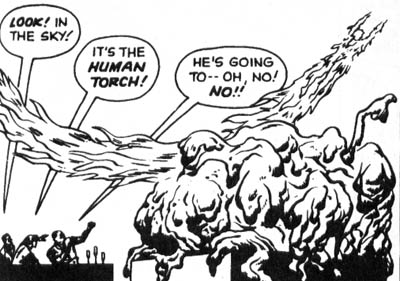 Mr. Fantastic's hand is spotten flipping off the one switch that controls the entire New York City power supply.
 Thus we are given a glimpse of the current Civil War storyline when the government declares the FF a threat to society due to their powers and herds them into specially designed prison cells without any kind of trial.
 Knowing their innocence can only be proven if they can escape and find the true culprits, the Four push their minds to the limit to devise a plan of escape.
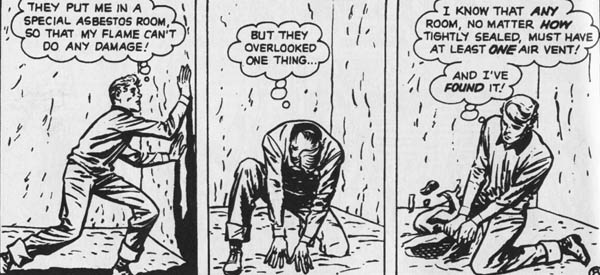 Quickly it becomes apparent the government didn't think too hard when putting together these "specially contructed private cells" when we learn the Torch is in an aesbestos-lined room.
 Hang on, didn't Torch just point out that "any room--no matter how tightly sealed--must have an air vent"? Why doesn't Reed just slip through the air vent? Perhaps the government realized that would be like an open door and actually made an airtight cell for Reed. In that case, they probably should have tested it to make sure it's actually airtight. Reed does, in fact, find a pinhole and slips through a few molecules at a time.
Having already exhausted himself coming up with two impossible escape scenarios, Stan gets even lazier for the last two.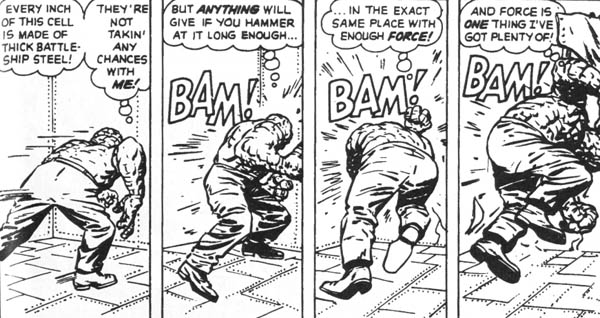 How did this idea develop?
Stan: Hmm, okay... so if they put the Thing into a regular cell, he could just punch through the wall and escape... so they'll have to make a cell with extra thick walls--
Jack: Made of reenforced steel!
Stan: Right! Something so thick and strong there's no way he can just punch his way out. He's going to have to use his head to get out of this one.
Jack: Alright, so how does he get out.
(Uncomfortable silence)
Stan: Uhhh...
Jack: He could hit it... several times?
Stan: Works for me!
But this is nothing compared to Sue's brilliant plan.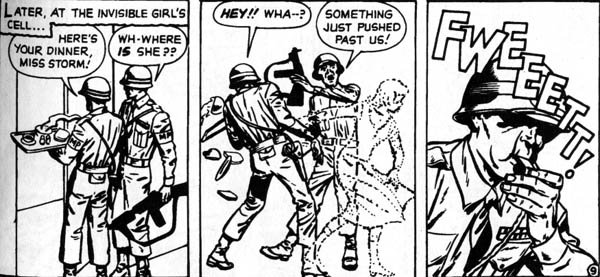 Apparently these soldiers were led to believe "Invisible Girl" was one of those reverse nicknames like calling a fat guy "Slim" or a tall guy "Tiny."
As I've been hyping all week, Invisible Girl was rather poorly written when Fantastic Four first hit the shelves. It should be noted, however, that the same can be said about the other three members of the team as well. For the first twenty issues (and maybe beyond... I haven't gotten to the second Essentials volume), calling the characters one-dimensional is being generous. Ben is angry, Johnny is cocky, Reed is smart, and Sue is... a girl.
Unfortunately, when it was pointed out by letter writers that Sue's character was as poorly developed as the others, but lacked any kind of useful powers to make up for the lack of depth, Stan Lee got a little offended and took it out on readers by having Reed threaten children.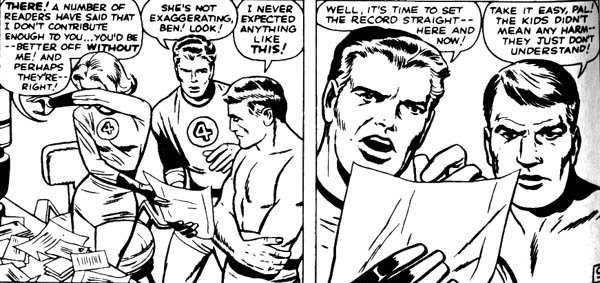 Okay, let's give Sue the benefit of the doubt. Maybe she really is an important cog in the FF wheel and we just haven't recognized it because Stan Lee's writing is so subtle and nuanced (which reminds me of another post I wanted to write regarding Essential Iron Man titled "Did Happy Hogan Ever Risk His Own Life to Save Tony Stark's and If So, Why Did Tony Go Four Whole Frames Without Mentioning It?").
Let's listen to the case for why Sue is important.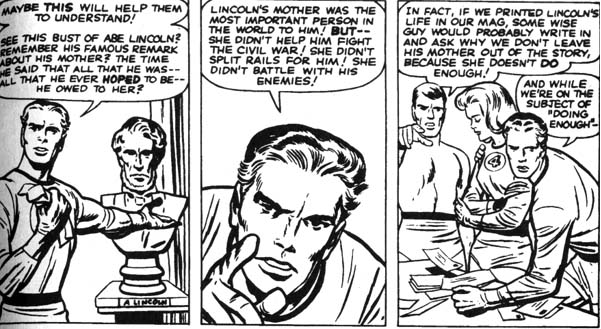 Uh... huh? This was really the best argument Stan could make? Is he trying to say Sue's like the team's mom? Because I love my mom a ton, but if I had to fight Skrulls or Dr. Doom, she'd stay her ass at home. No matter what kind of influence she's had on making me the man I am, when I have to go toe to toe with Red Ghost, her knees just wouldn't hold up, even if she could turn invisible.
Frankly, if I took my mom into a fight with Sub-Mariner and someone wrote me a letter suggesting I'd be better off taking Iron Man or Captain America or Spider-Man, I'd be hard pressed to argue with them, much less make a case for why my mom should be there in the first place.
Also, it should be considered that a comic book about Lincoln could safely contain several pages of scenes involving his mother as long as her influence was portrayed as important and there was an obvious connection to what she taught Abe and how it made him into the man whose face is on the five dollar bill.
If, instead, it's full of a bunch of scenes of his mother sitting around pining for the Prince of Atlantis, getting taken hostage every issue, and criticizing Commies, readers probably will question her value to the story, regardless of what the president might have said about her.
I'll accept that Abe's mom was a huge influence on his life, but if you're going to tell me a story about it, I expect that to be shown. Likewise, I'll accept that Invisible Girl is an important force in the Fantastic Four, but just saying it doesn't make it so. I need some proof, and Reed is willing to provide it.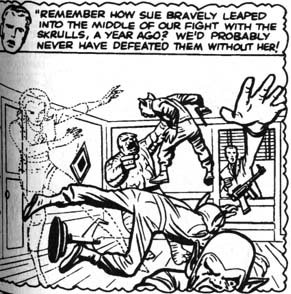 First off, wasn't Reed's point a minute ago that Abe Lincoln's mom didn't fight his enemies? Now he's trying to show Sue's importance by illustrating a time she fought an enemy?
While Reed is correct that Sue took part in this fight, she tripped a Skrull who was running away from the other three members of the FF. Certainly she may have prevented Reed from having to stretch his arm out and grab the Skrull's ankle or saved Johnny from having to fly a hundred or so yards in pursuit of the fleeing Skrull, it might be hyperbole to suggest they might not have won the fight without her.
This is generally how Invisible Girl participates in fights. Check out how she helped quell a prison riot in FF #8. Thing beats up a few dozen guys and builds a prison cell out of twisted girders. Reed uses himself as a shield to protect the team from some prisoners who have gotten ahold of machine guns, then disarms them from afar with his stretchy arm. Johnny traps a bunch of guys in a flaming circle. Sue...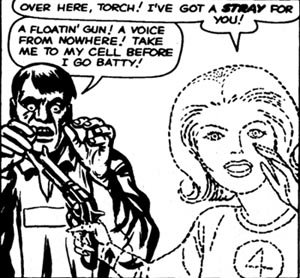 ... convinces one guy he's gone crazy by waving a gun in his face while invisible.
You know what's equally effective? Waving a gun in his face while not invisible.
Reed still has more case to make.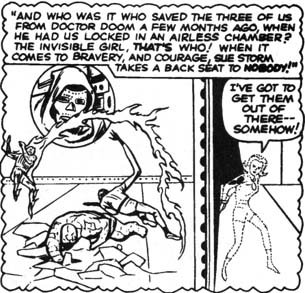 Again, while true, the circumstances are a little more revealing than the conclusion. Why wasn't Sue in the airless room with the rest of the team? Because Dr. Doom was using her as a hostage. He caught the entire team, then took Sue to his side because he knew she posed no threat.
Furthermore, the only reason she was able to spring them from the death chamber is because Doom got stupid and stopped paying attention to her. Aunt May could have done that, but she'd have done it with more panache and without openly lusting for Namor in front of Uncle Ben.
Oddly, the whole rant about the terrible readers who can't recognize Sue's value is interupted by a trouble alert from Johnny. Thing, Reed, and Sue rush to see what's wrong and find a birthday cake for Sue. Reed and Ben admit they've been keeping her busy while Johnny set up the surpise party, which implies Reed and Ben might have just made up the bad letters to keep her distracted.
Instead, I chalk it up to Stan Lee's furthering his lame explanation of how great Sue is through emotional manipulation. Earlier, he used the ploys of patriotism and motherhood, suggesting anyone who doesn't like Sue must also hate the mother of the Abraham Lincoln; now we're supposed to feel guilty for ruining her birthday.
When Sub-Mariner spends millions of dollars to buy a movie studio just so he can trick Reed, Johnny, and Ben into "starring in a film about the Fantastic Four" that winds up actually being a series of traps to kill them all off all in an effort to get into Sue Storm's panties (Hello, Google users!), what does Sue do to prove what a strong member of the team she is?
Well, for starters, she doesn't sleep with Namor... which is something... I guess. She turns invisible and throws books at him, which kind of defeats the purpose of being invisible considering even if I can't see you, but I'm being bombarded by a flurry of books flying from the bookshelf, I have a sneaking suspicion of where you might be.
Namor, however, doesn't need to use the book-flying logic since he has radar vision that allows him to see Sue even when she's invisible, which leads to: Sue being swept into Sub-Mariner's arms like a helpless baby while she kicks and screams and wishes the term "date rape" would hurry up and be invented a few decades early. Of course, before anything untoward can happen the FF men kick down the door and rush to the rescue.
But, as any frat boy can tell you, no means "NO!"... except when it means "maybe." Sue quickly gets between the boys and Namor, defending their would be murderer as misunderstood.
Keep in mind this guy just tried to feed her brother to a tribe of fireproof cannibals and stranded her supposed fiance on an island with an invincible cyclops who has killed everyone else who'd ever set foot on said island.
I've scanned a lot of frames to make my case for why Invisible Girl was worthless through the first ten issues of Fantastic Four and am coming up with too much material. So, here's one of the sequences that didn't make the cut. Saying that turning invisible before running into traffic is a stupid move will get Reed Richards all up in your face? What kind of supergenius defends invisible car dodging as a legitimate role on a superteam? She doesn't even stop to see if anyone survived the wreck nor to fill out a police report. What a superhero!
I also just noticed that What WERE They Thinking? and I posted the same frame on Thursday. He also has posted the "Abraham Lincoln's mother" sequence that serves as the basis for my eventual IGiW post.
I'm piecing together a post about Reed Richards's threatening of readers who felt Sue Storm didn't contribute enough to the team, highlighting her worthlessness through the first ten issues. However, as a prelude, I wanted to share this frame (from the very next issue following Reed's rant), wherein we learn just how Sue contributes to the team.
First, let's set the scene:
The Hulk is on the loose. General "Thunderbolt" Ross is appealing to the Fantastic Four to help capture/defeat/destroy the beast. Thing brags how he's going to beat the Hulk silly. Johnny describes how he'll trap the Hulk in a maze of fire and sweep him up in a flaming cyclone. Reed gets in on the trash talk, saying he'll press himself flat against the ceiling of a "specially prepared room" and wait for the Hulk to come inside, and drop from the ceiling like a giant net.
What will Sue do?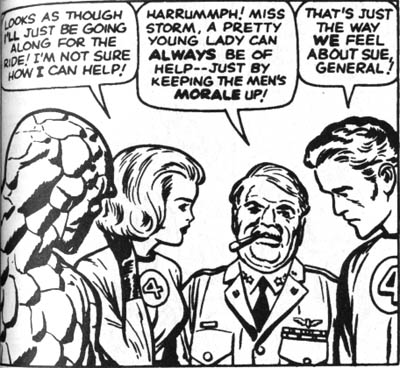 Sure. Why don't you just sing a song and show off them gams, baby?
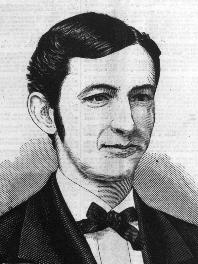 Candy Cummings pitched for five different teams in his six year baseball career. He led the league in shutouts in 1872 and 1875 and took the strikeout crown in '72 when he whiffed fourteen batters all season. His success was based largely on his ability to throw a curveball, something no other pitcher at the time could do. Cummings learned as a boy how to make clam shells follow a curving path when he threw them and applied the same principles to the baseball, spinning it as it left his fingertips and making it practically unhittable to batters of his era.
In 1939, he was inducted to the Baseball Hall of Fame as an pioneer of the game for his invention of the pitch that would be the predecessor to all breaking pitches.
If you were managing game seven of the World Series and could have any pitcher in the history of professional baseball on the mound, who would you want it to be? Whitey Ford? Tom Glavine? Sandy Koufax? Roger Clemens? Bob Gibson?
The obvious choice must be Candy Cummings, right? After all, if he hadn't invented the curveball, the rest of those guys would suck. He must be the best of all time and no one else could be considered superior since they used his own invention to exceed him, thereby negating their accomplishments.
The above argument makes little--if any--sense. Negating the accomplishments of some because they used the accomplishments of others as a leaping off point would discount nearly every one of mankind's highlights. Should every scientist that learned anything by looking through a microscope take a seat behind Hans Janssen since he invented the microscope? In turn, is the value of a microscope diminished by virtue of the fact someone else invented the convex lens?
Of course not. In fact, anyone who thinks George Mikan in his prime would average more than three points a game in today's NBA or believes "I Love Lucy" would last past midseason on today's networks is in denial.
Which brings me to Jack Kirby and Stan Lee.
I don't mean to single out any one person, as this is a commonly held feeling among some, but as part of the fifteen comics meme, Sean Kleefeld named Fantastic Four as his #1 comic and put his dream team of Stan and Jack aboard as creators. Let me stress, I'm not saying he's wrong, but just that I can't understand that choice at all (and if Sean's reading, I hope he'll post some kind of counterpoint reply to help me understand).
As I trudge through the first Essential Fantastic Four volume, I am struck by how terrible it all is. I understand it was a different time and it's a kids' book and it was surprisingly different than whatever else was out there, but none of that makes it "good." It has the stupidity of Jimmy Olsen, but with an added bombastic delivery that feels like its all taking itself far too seriously. Ten issues in, I can say there is nothing fun nor whimsical about this comic.
I will give Jack and Stan credit for being innovators without any question, but to say Jack Kirby is a better artist than Brian Hitch or than Stan Lee is a better writer than Peter David gives a little too much credit to nostalgia and not enough to the actual product of any of the men involved.
The fact is Brian Hitch--and most other artists today--are Kirby's superior because of Kirby himself. Kirby made considerable contributions to the art of sequential story telling. By experimenting with perspectives and layouts, he was able to give examples of what worked and what didn't, freeing up future artists from having to learn by conducting the same experiments. Likewise, as other artists took the lessons they learned from Kirby's work and conducted their own experiments, the lessons they learned were passed down, and so on. Each generation was able to build on the previous.
Thus, someone like Hitch or Lee Bermejo or Steve Epting or Mark Bagley represents the culmination of the works of Kirby, Ditko, Kubert, Eisner, Simonson, Perez, and so many others. Each creator has his own style, but a learned artist should easily exceed someone four decades his predecessor.
Unfortunately, there is an instict to cling to the past and point to innovations as summits rather than simply peaks along the escalation. How else do you explain people my age and younger paying good money to go see the Rolling Stones in concert? The idea that this was the pinacle of comic art: ... or that every writer's dialogue following that was a step down in quality is laughable at best and insulting at worst.
By all means, give Kirby and Lee the credit they deserve as creators, as innovators, as the foundations upon which Marvel Comics is built, but don't delude yourself into thinking a product either produced today would be anything but a major disappointment. When it comes right down to it, Kirby could never draw a person's head the same proportion twice and Stan's characters were so one dimensional, he once resorted to having Mr. Fantastic break the fourth wall and threaten readers who didn't think Sue Storm contributed anything to the book (which she didn't).
Recently, Brian Cronin posted his list of the top ten goofiest plot points in the first ten issues of Fantastic Four. I've been reading the first volume of the Essential Fantastic Four and can tell you Brian deserves our love, admiration, and support for narrowing down such a list. I'm only four issues in and already I've found about thirty things that defy explanation. I intend to address several of them in an upcoming theme week: Jack Kirby and Stan Lee are Overrated Hacks Week.
Robert brought up a good point that should be considered. Maybe some of the really stupid things that occur are the result of the Marvel Method. In the creation of Fantastic Four and other comics, Stan would write a list of plot points which Jack would illustrate and give back for Stan to script actual dialogue.
So when you find a ridiculous point like the following (I stole Brian's scan since it was in color and mine would be black and white) where Johnny, Ben, and Reed are transported back in time to a pirate cove and need some piratey clothes to blend in.
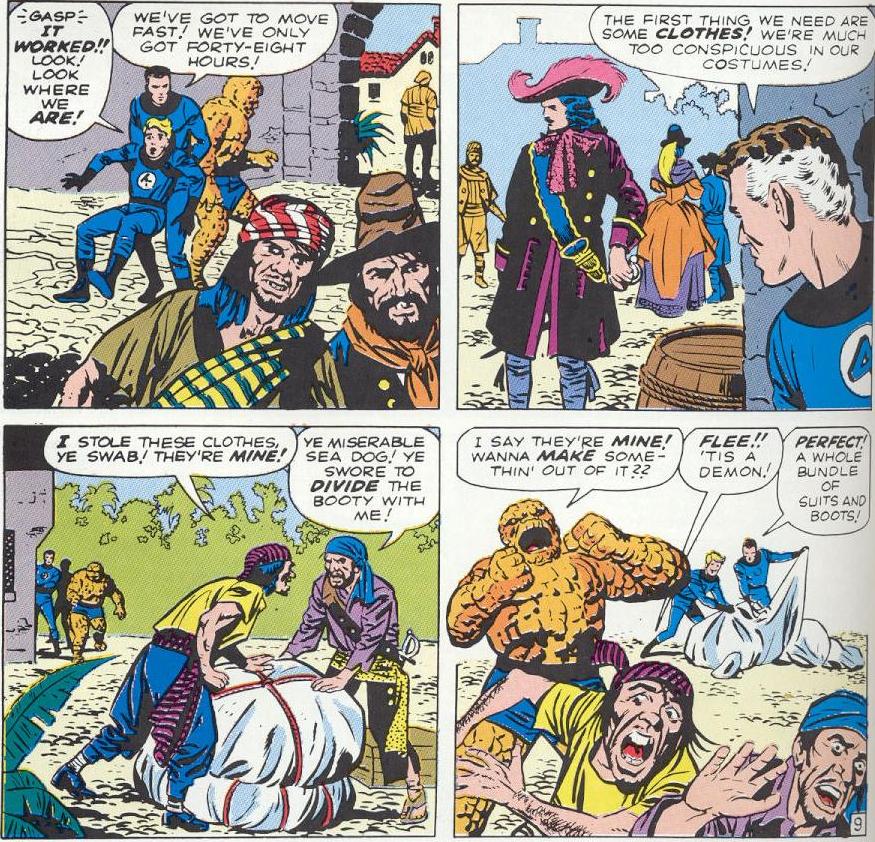
Stan probably wrote something like "They find some pirates arguing, attack them, and steal their clothes." Jack's interpretation was that the pirates had clothes to steal other than the ones on their backs. It didn't make much sense, but it's what Stan wrote and Jack had eight other comics to draw by 7PM so he drew them fighting over a bundle of clothes. Stan, in turn, had to write dialogue that would somehow explain why his plan for the Fantastic Three to mug some pirates had turned into a laundry heist.
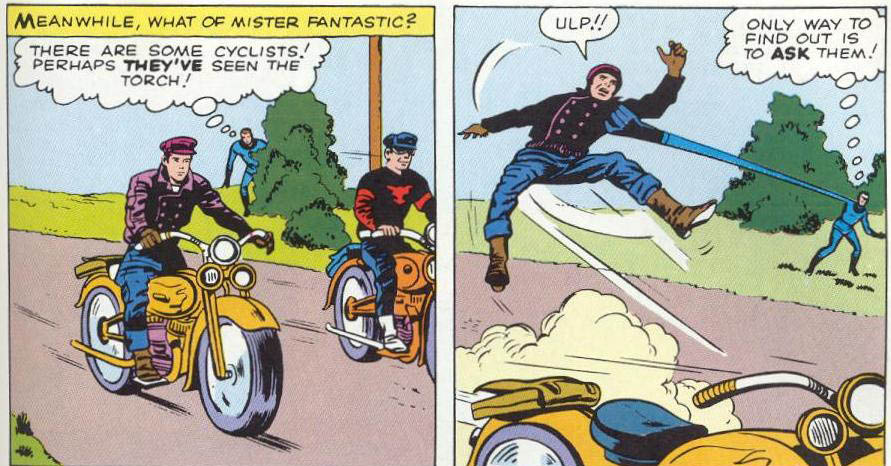
Look at some of the others as well, like this:
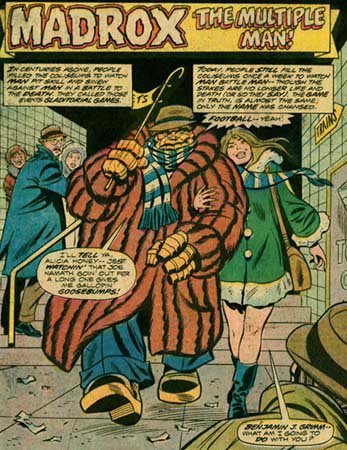
 We all have those lame characters that just click for us, even if everyone else thinks they suck. I liked Jamie Madrox, even before Peter David took over X-Factor back in the early 90's. David's portrayal quickly rocketed him to the top of my favorite characters list, prompting me to track down his first appearance in Giant Size Fantastic Four #4 from February of 1975, making him approximately three months younger than me.
Considering today we'll get a third issue of David's new run on X-Factor, I decided to revisit the original vision of Madrox and contrast it to the star of the current series.
First off, before you assume some no-name hacks are responsible for the following, let's place blame give credit where it belongs, on the shoulders of Chris Claremont, Len Wein, and John Buscema.
The story begins with Thing--dressed like it's the 1920's--hopping the subway to see Joe Namath and the Jets. The train has to stop though because someone is blocking the tracks. Thing decides to take matters into his own hands, walking across the roof of the train to find Madrox standing on the rails, surrounded by a glowing aura.
Jamie is excited to see someone else who is "different." Thing, unfortunately, is in no mood to play ambassador and when Madrox doesn't get off the track, Ben Grimm decides to settle things with his fists.
Thing weighs about 500 pounds, can lift more than 80 tons, and is covered in a rock-like hide, yet his first punch bounces off Madrox. A second punch causes Madrox to multiply and the two lay Thing out in one punch.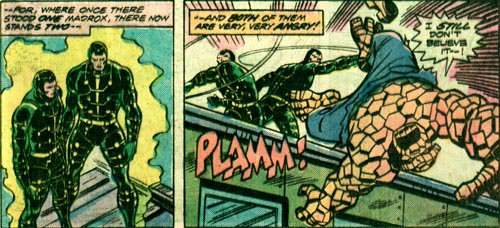 Thing tries to fight the Multiple Man, but every hit just adds new opponents. The Madroxes toss around the man who's held his own against the Hulk on many occassions as though he were a malnourished second grader fighting a yeti.
Six hours later, he wakes up in the Baxter Building, conveniently, just as Jamie Madrox is approaching. For some reason, Madrox has been walking from Queens into Manhattan, attracted to the Baxter Building "as a moth is drawn to a flame." As he walks, every electrical anything behind him goes dead.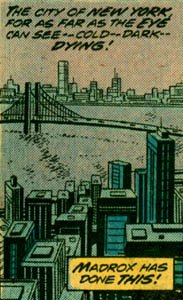 So far, he's beaten the Thing within an inch of his life and killed every electrical appliance in New York City. He also inexplicably makes it to the roof of the Baxter Building... somehow, where he meets Johnny Storm and needs all of one punch to take the Torch out of the fight.
 The punch so discombobulates Human Torch that he loses his flame and plummets from the roof toward certain death if not for the quick thinking and long reach of Mr. Fantastic.
Seeing as his two teammates have had their asses handed to them, Reed decides to go for the trifecta, using his stretchy powers to bind Madrox. To his credit, Mardox doesn't take him out with one punch and he does last longer than either Thing or Torch, but the end result is still the same.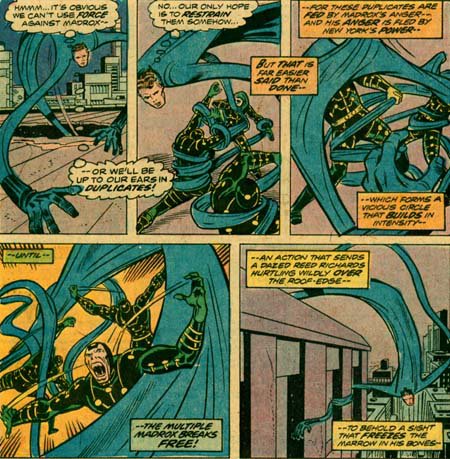 For the record, he smacks around Medusa (who was the replacement to Sue at the time) later as well. In the midst of the fight, Professor X shows up in a helicopter and tells us some of Jamie's biographical information. Madrox politely waits in the wings for the exposition to finish before unleashing his rage and a horrific smackdown upon the guys who made Galactus turn around and leave.
When Jamie was born, his powers were immediately apparent when the doctor slapped him on the butt and his turned into two babies. Jamie's dad, one of the nation's top scientists, abandonned his work on projects like solving world hunger to move to the middle of Kansas, far from anyone else, and raise his son in issolation. This was, we learn later, at the suggestion of Professor X. He invented for Jamie a suit that dampened the impacts that caused him to multiply.
When Jamie was fifteen, a tornado killed both his parents. He continued to live alone for six more years until electrical appliances started blowing up around him for no reason. At that point, he decided to walk from Kansas to New York, during which time no one noticed him until he stepped on the subway tracks in Queens.
Xavier figures out the suit is malfunctioning because no one has maintained it since Jamie's dad died. Raising several more questions than it answered.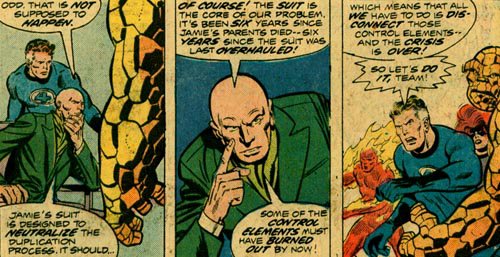 Where to begin? If some of the circuits are blown, removing them won't fix the problem. They'd need to be replaced. If the bulb in a lamp blows out, you don't light up the room just by unscrewing it. Second, Jamie's suit is designed to prevent his multiplying, disconnecting it won't prevent him duplicating again. Third, his suit, again, dampens impacts and prevents duplication. It doesn't give him superstrength nor invulnerability to fire. When the malfunction first occurs, it causes him great pain as the suit soaks up all the power of a TV and a blender. Shouldn't all the electricity of at least two boroughs have killed him? The explanation is given that somehow the power is fueling him, making him super strong and--I guess--giving him some kind of force field.
It's a stupid explanation.
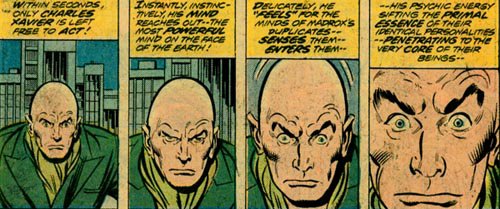
Anyway, the team that regularly faces off with Dr. Doom every other Tuesday and consistantly kicks his ass steels its courage and hopes against hope it can hold its own against another onslaught from Madrox. Reed Richards wrestles the original and fixes his suit while the rest of the FF pray their deaths with be quick and with honor. Fortunately, they have Professor X's power to elongate his head on their side. I forgot until I read this a second time that not everyone knew Professor X was a mutant at this time, so his pulling out the telepathy was a big deal.
The Professor thanks the Fantastic Four for their help and takes the unconscious Jamie Madrox for deprogramming.
Today, Madrox is a private detective who uses his duplicates to gather information for him, making it hard to believe he once was just one telepathic "Sleep, Jamie. Sleep." suggestion away from stomping a mudhole in the Beyonder.